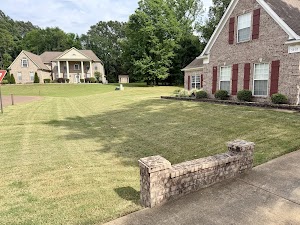

A Thick, Green, Weed‑Free Lawn in Memphis, TN
8 professional treatments a year, built for older Memphis yards, big trees, tired soil, and ground that was graded and filled long before you bought the place. Free service calls between visits.
Veteran‑Owned, Licensed in Tennessee, Serving Memphis Since 2006
Plans from $30.90 / Month
Or $46.35 per treatment, free, exact quote in minutes.
Get My Free Quote
Trusted by homeowners and property managers across Memphis
Our 8‑Application Program, Timed for Memphis
Timing is most of the job, and West Tennessee runs weeks ahead of the rest of the state. These windows come from University of Tennessee research for our end of the state, not a national calendar.
Visit 1 · Jan, Feb
We clear out winter weeds, chickweed, henbit, deadnettle, and sticker weed, while they are still small, and lay down a barrier that stops spring weeds before they come up.
Visit 2 · Feb, Mar
Crabgrass prevention. UT Extension puts the West Tennessee window at late February to early March, weeks earlier than East Tennessee, and earlier than any national calendar will tell you. The old rule still works: before the last forsythia bloom falls.
Visit 3 · Apr, May
First feeding of the year, at a rate matched to how much sun your yard actually gets. In a shaded Midtown or East Memphis yard, less nitrogen is the right answer, pushing growth in low light just makes thin, disease‑prone grass.
Visit 4 · May, Jun
Round two of weed prevention, about six weeks behind the first, so the barrier holds through summer. Plus feeding and nutsedge control.
Visit 5 · Jul, Aug
Summer feeding built for our heat, using a slow‑release product so it feeds steadily instead of burning. We also spot‑treat the tough summer weeds, crabgrass, goosegrass, and the sedges that take over low spots.
Visit 6 · Sep, Oct
Winter weed prevention. UT’s target is late August, before soil temperatures drop through 70 degrees, that is when annual bluegrass starts germinating. Miss it and you have it all winter.
Visit 7 · Oct, Nov
Fall follow‑up plus disease prevention. Fall is when spring dead spot takes hold in bermuda, it does not show up until the grass tries to green up in March, and by then prevention is off the table.
Visit 8 · Nov, Dec
Lime. Nearly every soil under Memphis is naturally sour, and sour soil keeps grass from using the fertilizer you already paid for.
Plans from $30.90 / Month
Or $46.35 per treatment. Every Memphis lawn is measured and priced to size, city lots vary enormously. Free service calls between visits. Get your exact number free, usually in a few minutes.
Why Memphis Lawns Behave the Way They Do
Memphis is an old city, and that is the whole story. Half the homes here were built before 1970, and the single biggest building decade was the 1950s. These are seventy‑year‑old lawns under seventy‑year‑old trees, on ground that has been cut, filled, and worked over more than once.
Half of Memphis Predates 1970
About half the homes in this city went up before 1970, compared with roughly one in twenty in Collierville. Seventy years of mowers, foot traffic, thatch, and whatever the last several owners did or did not do is all still in that ground.
A Lot of Memphis Isn’t Natural Soil
In an old city, the USDA maps roughly one acre in eight around here as graded, filled, or gullied ground, dirt with no natural layers left in it. Practically, that is why two houses on the same street can need completely different programs, and why your neighbor’s advice may not work in your yard.
Shade Changes by Neighborhood
Tree cover across Memphis swings from about a quarter of the ground in parts of Hickory Hill to more than half in Raleigh and High Point Terrace. Bermuda needs six or more hours of direct sun. Zoysia can live on two to four. The correct grass literally changes from one side of town to the other.
It Is the Dirt, Not the Water
Memphis tap water is famously soft and neutral, so irrigation is not what makes your soil sour, the ground has been that way since before the city was here. That means the only thing that actually fixes it is lime, and only after a test.
Hardpan on Some Streets, Not Others
A big share of Shelby County has a dense layer roots cannot cross, about two feet down. Other parts of the city sit on deep, well‑drained soil with no such layer at all. It is why one yard drains fine and the yard behind it stays soggy for a week.
Armyworms, and 2021 Was Bad
A University of Tennessee scientist based in West Tennessee called the 2021 armyworm year “epic,” said West Tennessee was worst hit, and reported that the usual insecticides were failing. Newly sodded lawns took the brunt. We scout in late summer rather than spraying on a schedule.
What Grows Well in Memphis
Tennessee sits in what UT Extension calls the transition zone, one of the hardest regions in the country to grow grass. In a city this shaded, the honest answer depends on your specific yard.
Bermudagrass
Excellent in the open, tough, fast to recover, best heat and drought tolerance we can grow. UT’s threshold is six or more hours of direct sun. If your yard does not get that, bermuda is the wrong grass fighting the wrong battle, no matter how good the program is.
Zoysia
The practical answer for a lot of Memphis. UT rates it for two to four hours of direct sun or a full day of filtered light, and it needs less nitrogen than bermuda. It is slow to establish and slow to recover, which is exactly why prevention matters more than repair with zoysia.
Deep Shade Has No Winner
We will be straight with you: under a ninety‑year‑old oak in Midtown, there is no grass that truly works. UT itself warns that grasses considered shade tolerant elsewhere often will not perform the same way here. Anyone promising a thick lawn in deep shade is overselling, beds and groundcover are the honest answer.
Our Calendar Is Not Nashville’s
UT Extension separates West Tennessee from East Tennessee by weeks on weed prevention alone. A statewide or national schedule will have you putting product down after the crabgrass has already come up.
Test, Do Not Guess
UT does not publish a blanket fertilizer rate for Tennessee lawns; it routes homeowners to a soil test instead. In a city where a lot of the ground is fill, that is not a formality, it is the only way to know what you actually have.
It was all weeds when I moved in, and after being treated, I have no weeds in my yard at all.
Michelle H. · Lawn Jox customer
Why Memphis Homeowners Choose Lawn Jox
Free Service Calls
Our job is to make sure your lawn is beautiful all season long. If you think there is something wrong with your lawn, call us. The inspection is free.
Professional, Uniformed Crews
Just like your lawn, we have standards with our appearance as well. All of our lawn care technicians are uniformed and professional.
Licensed in TN, MS & AR
Treating a lawn for hire in Tennessee takes more than a mower. The state requires a Department of Agriculture charter for the business, one per location, plus a licensed supervisor and certified applicators, backed by a bond and liability insurance. We hold licenses in Tennessee, Mississippi and Arkansas. Ask anyone else working your street for their charter.
Electronic Quotes & Invoicing
We save on paper and make it easy to pay. With our electronic system, you’ll receive quotes and invoices on your devices so you can accept bids and pay invoices all online.
Memphis Lawn Care, Common Questions
Straight answers on shade, city code, rentals, and licensing.
How much does lawn treatment cost in Memphis?
Our program starts at $30.90 a month, or $46.35 per treatment if you would rather pay per visit. Price depends on the size of your lawn, so we measure it and give you an exact number, free, and usually in a few minutes.
Do I have to sign a contract?
Yes. Our plans run on an annual service agreement. Full terms, including renewal and cancellation, are on our Terms of Service page.
Do you work with rental properties and property managers?
Yes, and Memphis is the market for it, there are more than fifty thousand rented single‑family houses in this city, more than the entire housing stock of Germantown, Collierville and Bartlett put together. We handle single properties or whole portfolios with per‑address billing.
My lawn is bare under the trees. Can you fix it?
We can improve it, and we will tell you honestly where the ceiling is. UT Extension says bermuda needs six or more hours of direct sun; zoysia can manage on two to four. Below that, no program makes grass thick. What works in shade is mowing higher, feeding less, watering deeply but rarely, and keeping traffic off.
I got a letter about my grass height. What is the rule?
The City of Memphis sets the threshold at 12 inches, and it is enforced mainly on vacant and neglected property. The city mows thousands of lots a year, bills the owner by the hour, and can put a lien on the property if it goes unpaid.
Are there watering restrictions in Memphis?
Not right now. MLGW has a four‑phase drought plan that could restrict outdoor watering if demand stayed very high for two weeks straight, but it was last in effect in 2022 and was lifted that December. Worth knowing: that plan covers Memphis but not Bartlett, Collierville, or Germantown, which run their own water systems.
When does weed prevention need to go down?
UT Extension puts the West Tennessee crabgrass window at late February to early March, before the last forsythia bloom falls, and the winter weed application in late August, before soil temperatures drop through 70 degrees.
What parts of Memphis do you serve?
All of it, plus Bartlett, Cordova, Germantown, Collierville, Arlington, Lakeland, and Eads, and our home base across the line in DeSoto County, Mississippi.


What I also appreciated was how efficient and respectful the team was while on-site. No mess left behind, everything was cleaned up, and they made sure the yard looked better than they found it.
Overall, excellent service from start to finish. Reliable, professional, and they deliver exactly what you’d expect—and more. Can’t wait until my next service provided by Lawn Jox and would recommend them to anyone looking for quality lawn care.